Description
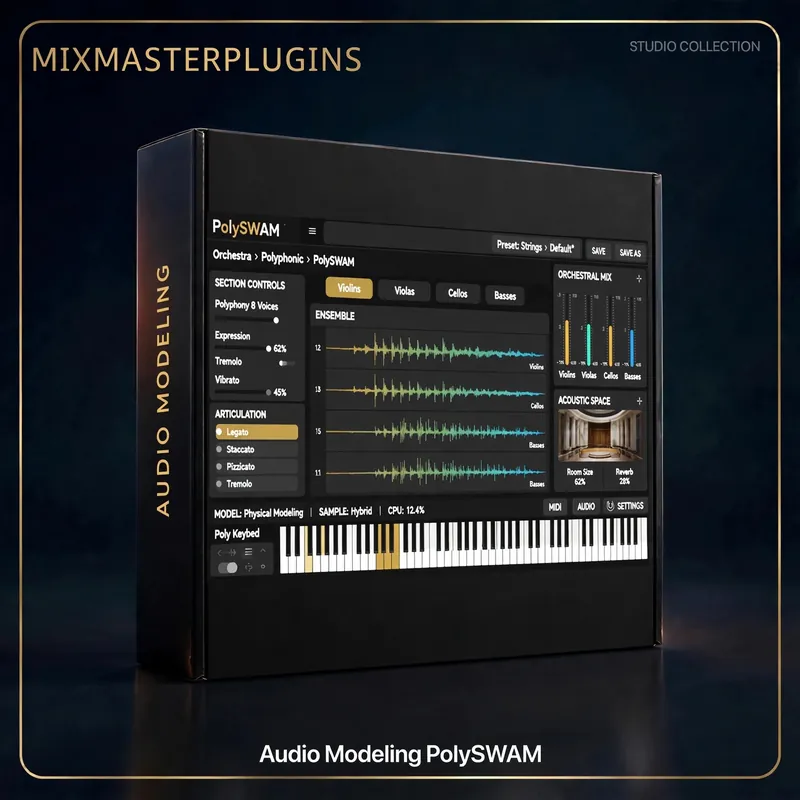
Audio Modeling PolySWAM — Physical Modeling, Polyphonic at Last
Thirty-seven physically modeled instruments. Zero samples. One polyphonic engine. Available for both Windows and Mac.
Why Modeling Sounds Different
Every conventional virtual orchestra is a recording collection. Engineers captured world-class players in great rooms, sliced the performances into thousands of samples, and mapped them across the keyboard. The results can be impressive — but they are, fundamentally, frozen moments. A sampled crescendo is a crossfade between a quiet recording and a loud one. A sampled legato is two recordings stitched together. No matter how many velocity layers you stack, you’re hearing what someone else played, on a different day, in a different room.
Physical modeling takes the other path. Instead of recording the instrument, it simulates it. PolySWAM’s SWAM engine computes the vibrating string, the air column, the reed, the player’s embouchure and bow arm — in real time, sample by sample. The sound you hear was never recorded; it was calculated from the physics of the instrument responding to your MIDI input at this exact moment.
The sonic consequence is continuity. Where samples jump between layers, modeling glides. Where samples repeat identically, modeling never plays the same note twice — because the physical state of the virtual instrument is always slightly different, exactly like the real thing.
The Polyphony Breakthrough
Audio Modeling resisted polyphony for years, and for good reason: stacking monophonic modeled lines naively would sound like several soloists playing in unison, not an ensemble. The breakthrough in PolySWAM is its intelligent voice-allocation core — a real-time system that treats your performance as an ensemble score and distributes notes across virtual players, each maintaining its own physical state, articulation, and timing.
This is a genuine engineering achievement, not a marketing layer. Each voice in a PolySWAM chord is an independent physical model with its own bow pressure, breath, and resonance — interacting the way real players interact, with the microscopic timing and tuning variations that make an ensemble sound alive rather than cloned.
What 37 Models Actually Give You
PolySWAM includes the complete SWAM instrument collection: solo strings (violin, viola, cello, double bass), the full woodwind family (flutes, clarinets, oboes, bassoons, saxophones), brass (trumpets, trombones, horns, tubas), and curated ensemble configurations. Every one of them is a full physical model, not a simplified “ensemble patch” approximation.
For mix engineers, this matters at the source. Modeled instruments sit in a mix differently than sampled ones: the absence of room baked into every sample means you control the space entirely with your own reverb; the continuous timbral response means EQ moves behave predictably across the dynamic range; and the lack of round-robin repetition means exposed passages never reveal the “machine gun” artifacts that betray sample libraries in sparse arrangements.
Articulation as Physics, Not Keyswitches
In a sample library, articulation is a switching problem: which recording do I trigger? In PolySWAM, articulation is a physics problem: what is the player doing? Short, detached input produces staccato because a real player detaching notes sounds that way. Connected phrasing produces legato because the model connects them. Pitch slides bend through portamento because the physical model allows it.
For production, this means articulation automation becomes performance automation. Instead of programming keyswitch lanes, you shape continuous controller data — dynamics, expression, vibrato — and the instrument responds with the complexity of a real performance. The MIDI you record is smaller, cleaner, and infinitely more editable.
Technical Specifications
- Engine: SWAM physical modeling with real-time intelligent MIDI voice allocation
- Instruments: 37 SWAM acoustic models (strings, woodwinds, brass, ensembles)
- Formats: Standalone, AU, VST, VST3, AAX (64-bit); NKS support (VST3)
- Platform: Windows + macOS
- Activation: Internet connection required
Platform Availability
Available for both Windows and Mac. Runs natively on Apple Silicon and Intel Macs, plus Windows 10/11.
Price and License
Regular price €399, now €79.99. Every customer receives their own individual license key.
PolySWAM is the first instrument to make SWAM’s physical modeling truly polyphonic — and for engineers and producers who care about how sound is actually generated, it’s the most sonically honest virtual ensemble available. No samples. No loops. Just physics, played in real time.


Reviews
There are no reviews yet.