Description
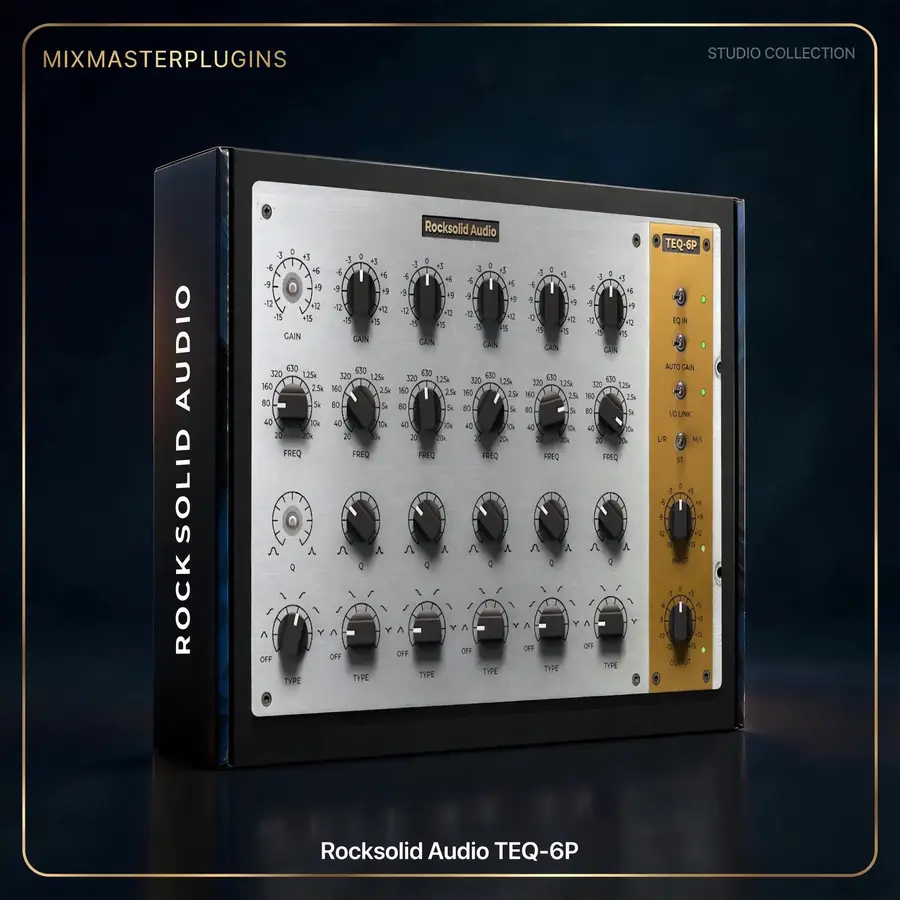
Rocksolid Audio TEQ-6P — A Valve EQ Built for Real Mix Sessions
Every mix engineer knows the two kinds of EQ moves: the surgical ones and the colourful ones. Surgical moves need a clean, precise tool. Colourful moves need something with soul — and that’s where most digital EQs fall short, because their “character” is a coat of paint over a clean filter. The Rocksolid Audio TEQ-6P is built differently: it’s a six-band parametric valve EQ running a real-time SPICE simulation of an actual analog circuit. Every resistor, capacitor, coil, valve and transformer is wired together like real hardware, and your audio passes through that live circuit with 0ms latency. The colour isn’t added on — it’s what the circuit does.
Please note: this download is Mac only. TEQ-6P is available in AU, VST3 and AAX for macOS 13 or later (Intel and Apple Silicon).
Surgical Moves vs Colourful Moves — One Plugin for Both
Here’s the workflow reality: you reach for different EQs at different stages. Cleaning up a muddy low-mid buildup on a vocal? That’s a job for precision. But the final moves — the lift that makes the vocal sit, the weight that makes the kick feel expensive, the air that opens up the master — those are feel moves, and feel moves want a circuit that responds like hardware.
TEQ-6P covers both ends because its six bands have the broad, musical curves of real tube circuitry: forgiving enough that small moves never sound harsh or phasey, yet precise enough to notch and shape with intent. And because it’s a simulated circuit rather than a static model, the bands interact with the valves and transformers organically — push a band harder and the circuit pushes back the way real electronics do. You can make bold, colourful moves without the brittle edge that clean digital EQs develop when driven.
Mid/Side and L/R: Stereo Control Where It Counts
Serious mix and master work happens in the stereo field, and TEQ-6P is equipped for it. Mid/Side processing lets you shape the center and sides independently — the classic mastering moves: tighten the low end in the mid without collapsing the stereo width, add air and openness to the sides while the vocal stays anchored in the center, tame harshness in the sides of an overhead pair without dulling the snare in the middle.
L/R processing handles the asymmetric cases: a guitar panned left that’s brighter than its right-side counterpart, a stereo synth with an uneven low end. Independent left/right EQ, through a valve circuit, with total recall. It’s the kind of control that usually requires either hardware with dual-mono switching or a chain of plugins — here it’s built in.
Auto Gain and Gain Staging: Judge the Move, Not the Volume
The oldest trap in EQ is loudness: a boost sounds better partly because it’s louder. TEQ-6P’s auto gain compensates so you can A/B your moves honestly — what you’re hearing is the tone change, not a level change. Combined with the Input/Output Link, which keeps gain staging coherent through the circuit, you get a workflow where every decision is made on the merits of the sound. When you’re making the final 1–2 dB moves on a master, that honesty is everything.
Oversampling and Zero-Latency Circuit Response
Pushing high frequencies through nonlinear circuits can generate aliasing — the harsh, unmusical artifacts that betray a cheap simulation. TEQ-6P’s oversampling keeps the top end clean even when the circuit is working hard, so your air boosts stay silky. And the simulation itself runs with 0ms latency: no buffering, no lookahead, no phase weirdness when you parallel-process or use it on a live-monitored track. It behaves like hardware in the signal path — immediate.
Two Interfaces for Two Working Speeds
Mix sessions have two tempos: the careful, ears-first pass and the fast, deadline-driven pass. TEQ-6P’s Classic UI — knobs, switches, no analyser — forces you to listen, the way engineers did when valve EQs were the only option. The Modern UI adds an FFT display and grabbable EQ bands for when you need to see what you’re doing and move fast. Both drive the identical simulation engine, and your settings carry over when you switch. Start a mix in Modern for speed, finish the master in Classic for judgement.
Three Valves, Three Transformers: Voicing as a Mix Decision
Voicing isn’t just flavour — it’s a mix decision. The three valve styles change the harmonic character of the entire circuit: pick the one that flatters the source, the way you’d choose between hardware units. The three transformer styles control the weight and transient behaviour — the iron that gives drums their thump and masters their density. Nine combinations, each a genuinely different-sounding circuit, switchable in a click. In a mix workflow, that means auditioning hardware personalities the way you’d audition mics: fast, musical, decisive.
A Typical Session Flow
On individual tracks, TEQ-6P adds the finishing colour: presence on vocals without harshness, body on snare, weight on kick and bass. On buses, it glues — drums, guitars, backing vocals take on a cohesive analog sheen. On the master, it does the final tone shaping that makes a mix feel finished: a touch of fullness down low, a breath of openness up top, the midrange sitting exactly where it should. One plugin, three stages of the mix, one consistent analog character throughout.
System Requirements (Mac Only)
- macOS 13 or later — Intel and Apple Silicon
- Formats: AU, VST3, AAX
- Display 1440×900 or 1280×960 or higher
- 2 GB RAM
Please note: this download is Mac only.
FAQ
How does TEQ-6P fit into a mastering chain?
Put it where you’d put a hardware tube EQ: after your corrective digital EQ, before your limiter. Use Mid/Side mode for stereo shaping, auto gain for honest comparisons, and small moves — the circuit’s musical curves mean 1–2 dB does real work.
Can I use it for Mid/Side mastering?
Yes. TEQ-6P includes dedicated Mid/Side processing alongside L/R processing, so you can shape the center and sides independently — ideal for widening air, tightening low-end focus, or taming side-channel harshness.
Does the zero-latency processing matter for mixing?
Yes — 0ms latency means no delay compensation artifacts, no phase issues in parallel chains, and no problem using it on tracks you’re monitoring live. It behaves like hardware in the signal path.
Is it Mac only?
Yes — please note: this download is Mac only (AU/VST3/AAX, macOS 13 or later, Intel and Apple Silicon).

Reviews
There are no reviews yet.