Description
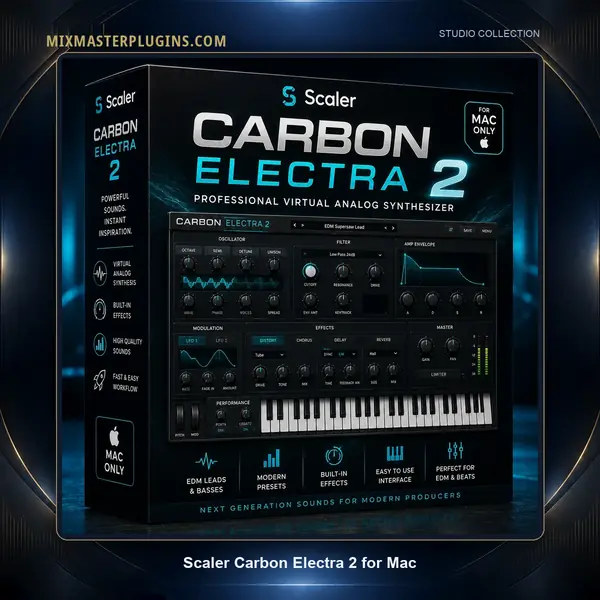
Most virtual analog synths compete on oscillator count. Scaler Carbon Electra 2 competes on something more practical: time-to-finished-sound. The architecture is deliberately streamlined — a warm virtual analog engine, a large library of current genre presets, and a complete onboard effects suite — so the path from blank project to release-ready synth part is as short as possible.
The full instrument is €39.99 here, with your own license key and email delivery.
An honest design brief
Carbon Electra 2 knows what it is: a fast, great-sounding workhorse for modern electronic production, not a modular playground. The virtual analog engine delivers the thick leads, weighty basses and lush pads the genre requires, voiced with the warmth that keeps digital productions from sounding sterile. The interface exposes what you need and hides what you do not — a design decision more synths should make.
The library as instrument
The preset collection — leads, basses, pads, plucks, arpeggios, FX, keys, sequences — is the real product here. These are contemporary sounds programmed for EDM, house, future bass, trap and pop, and they are mixed with an awareness of how they will sit in a dense arrangement. For engineers, that means less corrective EQ and fewer layering workarounds: the sounds arrive with their frequency roles already considered.
Self-contained signal chain
The onboard FX — reverb, delay, chorus, distortion, EQ, compression, phaser, stereo enhancement — remove the most common reason to reach for external plugins during sound selection. Auditioning presets with their intended processing in place gives a far more accurate picture of the final result than dry oscillators ever could, and it keeps template sessions lean. For mix engineers, the practical benefit is consistency: the width and space decisions are baked into the patch, so the sound behaves predictably when the arrangement fills up.
Template thinking
Smart template builders keep one fast synth permanently loaded, and Carbon Electra 2 is an ideal candidate: low friction, broad coverage, mix-ready output. Route it to a dedicated instrument track with your go-to channel strip after it, save that as your default, and every new project starts with professional synth sounds one click away. That kind of session infrastructure is what separates productive studios from plugin collectors.
Why engineers buy from MixMasterPlugins
MixMasterPlugins serves people who value tools that respect session time. Every customer receives their own individual license key, a secure download link sent to your email, and support from people who understand production. At €39.99, Carbon Electra 2 is a low-risk, high-return addition to any electronic template — see the shop for more, or the Synth Plugins category for the instrument shelf.
Frequently asked questions
What is the core strength of Carbon Electra 2?
Speed: a strong virtual analog engine plus a deep, current preset library and full onboard FX, optimized for finishing tracks.
Is the preset library genuinely useful or filler?
It is the instrument’s centerpiece — modern, genre-correct sounds for electronic production, programmed to sit well in mixes.
Can it handle bass duties?
Yes — deep sub, punchy and aggressive basses are among its strongest categories.
What about the effects quality?
The eight onboard processors — including compression, EQ and stereo enhancement — are genuinely usable for final polish.
How is it delivered?
A secure download link is sent to your email, typically within minutes of checkout.
Workflow-first synthesis at an honest price. Scaler Carbon Electra 2 earns its place in the template.
Most virtual analog synths compete on oscillator count. Scaler Carbon Electra 2 competes on something more practical: time-to-finished-sound. The architecture is deliberately streamlined — a warm virtual analog engine, a large library of current genre presets, and a complete onboard effects suite — so the path from blank project to release-ready synth part is as short as possible.
Most virtual analog synths compete on oscillator count. Scaler Carbon Electra 2 competes on something more practical: time-to-finished-sound. The architecture is deliberately streamlined — a warm virtual analog engine, a large library of current genre presets, and a complete onboard effects suite — so the path from blank project to release-ready synth part is as short as possible.
The full instrument is €39.99 here, with your own license key and email delivery.
An honest design brief
Carbon Electra 2 knows what it is: a fast, great-sounding workhorse for modern electronic production, not a modular playground. The virtual analog engine delivers the thick leads, weighty basses and lush pads the genre requires, voiced with the warmth that keeps digital productions from sounding sterile. The interface exposes what you need and hides what you do not — a design decision more synths should make.
Carbon Electra 2 knows what it is: a fast, great-sounding workhorse for modern electronic production, not a modular playground. The virtual analog engine delivers the thick leads, weighty basses and lush pads the genre requires, voiced with the warmth that keeps digital productions from sounding sterile. The interface exposes what you need and hides what you do not — a design decision more synths should make.
The library as instrument
The preset collection — leads, basses, pads, plucks, arpeggios, FX, keys, sequences — is the real product here. These are contemporary sounds programmed for EDM, house, future bass, trap and pop, and they are mixed with an awareness of how they will sit in a dense arrangement. For engineers, that means less corrective EQ and fewer layering workarounds: the sounds arrive with their frequency roles already considered.
The preset collection — leads, basses, pads, plucks, arpeggios, FX, keys, sequences — is the real product here. These are contemporary sounds programmed for EDM, house, future bass, trap and pop, and they are mixed with an awareness of how they will sit in a dense arrangement. For engineers, that means less corrective EQ and fewer layering workarounds: the sounds arrive with their frequency roles already considered.
Self-contained signal chain
The onboard FX — reverb, delay, chorus, distortion, EQ, compression, phaser, stereo enhancement — remove the most common reason to reach for external plugins during sound selection. Auditioning presets with their intended processing in place gives a far more accurate picture of the final result than dry oscillators ever could, and it keeps template sessions lean. For mix engineers, the practical benefit is consistency: the width and space decisions are baked into the patch, so the sound behaves predictably when the arrangement fills up.
The onboard FX — reverb, delay, chorus, distortion, EQ, compression, phaser, stereo enhancement — remove the most common reason to reach for external plugins during sound selection. Auditioning presets with their intended processing in place gives a far more accurate picture of the final result than dry oscillators ever could, and it keeps template sessions lean. For mix engineers, the practical benefit is consistency: the width and space decisions are baked into the patch, so the sound behaves predictably when the arrangement fills up.
Template thinking
Smart template builders keep one fast synth permanently loaded, and Carbon Electra 2 is an ideal candidate: low friction, broad coverage, mix-ready output. Route it to a dedicated instrument track with your go-to channel strip after it, save that as your default, and every new project starts with professional synth sounds one click away. That kind of session infrastructure is what separates productive studios from plugin collectors.
Smart template builders keep one fast synth permanently loaded, and Carbon Electra 2 is an ideal candidate: low friction, broad coverage, mix-ready output. Route it to a dedicated instrument track with your go-to channel strip after it, save that as your default, and every new project starts with professional synth sounds one click away. That kind of session infrastructure is what separates productive studios from plugin collectors.
Why engineers buy from MixMasterPlugins
MixMasterPlugins serves people who value tools that respect session time. Every customer receives their own individual license key, a secure download link sent to your email, and support from people who understand production. At €39.99, Carbon Electra 2 is a low-risk, high-return addition to any electronic template — see the shop for more, or the Synth Plugins category for the instrument shelf.
MixMasterPlugins serves people who value tools that respect session time. Every customer receives their own individual license key, a secure download link sent to your email, and support from people who understand production. At €39.99, Carbon Electra 2 is a low-risk, high-return addition to any electronic template — see the shop for more, or the Synth Plugins category for the instrument shelf.
Frequently asked questions
What is the core strength of Carbon Electra 2?
Speed: a strong virtual analog engine plus a deep, current preset library and full onboard FX, optimized for finishing tracks.
Is the preset library genuinely useful or filler?
It is the instrument’s centerpiece — modern, genre-correct sounds for electronic production, programmed to sit well in mixes.
Can it handle bass duties?
Yes — deep sub, punchy and aggressive basses are among its strongest categories.
What about the effects quality?
The eight onboard processors — including compression, EQ and stereo enhancement — are genuinely usable for final polish.
How is it delivered?
A secure download link is sent to your email, typically within minutes of checkout.
Workflow-first synthesis at an honest price. Scaler Carbon Electra 2 earns its place in the template.

Reviews
There are no reviews yet.